Gum disease treatment: from professional cleaning to periodontal therapy
How gingivitis and periodontitis are diagnosed and treated, what deep cleaning involves, what recovery is like and why daily care decides the outcome.
- Verfasst von
- HealthNaro Editorial Team
- Veröffentlicht
How this page was made: Drafted by the HealthNaro Editorial Team with AI assistance, checked against reputable health sources, and not yet clinically reviewed. Editorial policy
Noch nicht klinisch geprüft
What it is
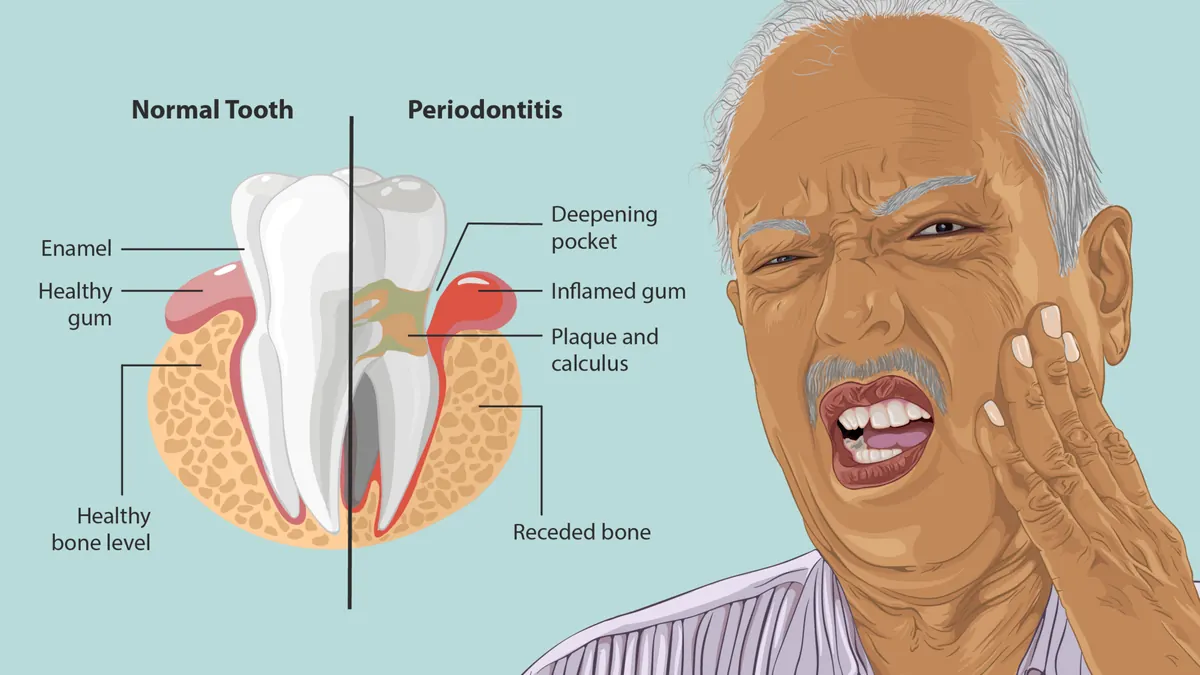
Gum disease is inflammation of the tissues that hold the teeth in place. In its early, reversible form, gingivitis, the gums are red, swollen and bleed when brushed. If it progresses to periodontitis, the bone and ligament supporting the teeth are gradually destroyed, pockets form between gum and tooth, and teeth can loosen and eventually be lost. The World Health Organization's oral health fact sheet (updated 17 March 2025) estimates that severe periodontal disease affects more than one billion people worldwide.
Treatment aims to remove the bacterial plaque and hardened deposits (calculus) that drive the inflammation, both above and below the gumline, and then to keep them from returning. The NHS gum disease page (reviewed 20 April 2026) describes a stepped approach: in early disease, advice on cleaning, help to stop smoking and a professional clean; in more serious cases, deep cleaning under the gums, antibiotics in selected situations, gum surgery and, where teeth cannot be saved, extraction.
Who it is for and when it is recommended
Anyone whose gums bleed on brushing or flossing, feel sore or look swollen should have them assessed. Other signs listed by the NHS include bad breath or a bad taste, gums shrinking away from the teeth, loose teeth and dental abscesses. Periodontitis often progresses without pain, so it is frequently picked up at a routine check-up when the dentist measures pocket depths with a fine probe.
Risk is higher in people who smoke, who have diabetes, who have a family history of early tooth loss, or who find it hard to clean thoroughly, for example around crowded teeth, braces or partial dentures. The WHO notes that diabetes and periodontal disease are linked in both directions.
What happens at the appointment
Assessment. The clinician records bleeding, measures the depth of the pockets around each tooth, checks for mobility and may take X-rays to see bone levels. This gives a baseline against which progress is measured.
Oral hygiene instruction. You are shown techniques for your mouth, usually including interdental brushes or floss sized for your gaps. This is treatment, not an afterthought; nothing else works without it.
Scaling and root surface debridement. Using ultrasonic and hand instruments, the clinician removes calculus and plaque from above and below the gumline, including along the root surfaces inside the pockets. Local anaesthetic is usual when pockets are deep. The mouth is often treated in sections over two to four visits.
Reassessment. Around six to twelve weeks later, pockets are measured again. Many shrink as inflammation settles.
Further treatment. Sites that remain deep may be re-treated, treated surgically to gain access and reshape the bone or gum, or, where a tooth has lost too much support, extracted. Antibiotics are not routine and are reserved for specific situations.
Maintenance. Supportive visits every three to six months are the norm for people who have had periodontitis.
How to prepare
Bring a list of medicines and tell the clinician about diabetes, heart conditions, pregnancy, blood thinners and smoking. If you have a glucose monitor, know your recent control; it affects healing. Begin improving your home cleaning before the first deep cleaning, since gums that are less inflamed bleed less and are easier to treat. If you smoke, ask about support to stop; the NHS lists smoking cessation as part of treatment, not an optional extra.
Afterwards and recovery
After deep cleaning, gums are often tender for a few days and teeth can be sensitive to cold for several weeks because root surfaces that were covered by calculus or swollen gum are now exposed. As swelling reduces, gums may appear to shrink, teeth can look longer and small gaps may open between them; this is a sign of healing rather than harm, but it is worth knowing in advance. Slight bleeding on brushing usually stops within a week or two of consistent cleaning. Follow the specific technique you were shown, every day, and keep the review appointment, because that is where the clinician learns whether the treatment has worked.
Risks and limitations (sourced)
Treatment can stop periodontitis progressing but cannot regrow lost bone or gum in most cases, so recession and sensitivity may be permanent. Teeth that have already lost a great deal of support may be lost despite treatment. The NHS is clear that the disease is caused by plaque that regular brushing and cleaning between the teeth has not removed, which means it returns if home care lapses; maintenance visits are lifelong for people who have had periodontitis. Surgical treatment carries the usual risks of pain, swelling and infection. Where an abscess forms, the NHS dental abscess page (reviewed 18 March 2026) stresses that it needs urgent treatment and will not go away on its own.
What affects the cost
Fees vary by country, city and clinic. Factors include:
- Severity: the number of teeth and the depth of pockets involved.
- The number of visits needed to treat the whole mouth.
- Whether treatment is by a general dentist, a hygienist or a specialist periodontist.
- Whether X-rays and anaesthetic are itemised separately.
- Whether surgery, bone grafting or extractions are needed.
- Long-term maintenance visits, which are a recurring cost.
- Coverage by a national scheme or insurance.
Ask for an itemised written plan that separates the first phase of treatment from maintenance. HealthNaro does not publish prices unless they come from a named, dated source.
Questions to ask the provider
- What stage is my gum disease at, and how many teeth are affected?
- What are my pocket depths now, and what would count as success at reassessment?
- How many visits will the first phase take, and will I need anaesthetic?
- Who will carry out the treatment, and should I see a specialist?
- Which interdental tools and sizes do you recommend for me?
- How often will I need maintenance visits afterwards?
- What is the total price, itemised, and what does maintenance cost?
How to find and check a provider
HealthNaro lists dental clinics, dentists and periodontists with a verification label on every listing. Public listing means the details came from public sources and have not yet been checked. Contact verified means the provider has confirmed their phone number and email address. Reviewed by HealthNaro means our team has looked over the listing's details. Credentials verified means we have seen a licence or registration document. A label describes what has been checked; it is not a recommendation or a ranking, and HealthNaro does not endorse any provider.
Check the practitioner's registration with your national dental regulator and, for advanced disease, ask whether specialist periodontal care is advisable. You can browse providers under Periodontics. If you would like help finding a suitable clinic, our consulting service is free: send a request through the inquiry form and we will come back to you with options. You choose whom to contact.
This guide is general information, not dental advice. Speak to a registered dentist about your own situation.
Wenn Sie glauben, einen medizinischen Notfall zu haben, kontaktieren Sie sofort den örtlichen Notdienst oder gehen Sie in die nächste Notaufnahme. Warten Sie nicht auf die Antwort eines Verzeichniseintrags.
Brauchen Sie Hilfe bei der Suche nach periodontics?
Sagen Sie uns, was Sie brauchen und wo. Wir melden uns bei Ihnen, verstehen Ihre Situation und helfen Ihnen, eine geeignete Klinik zu finden und auszuwählen. Dieser Service ist für Patienten kostenlos.
Passende Ratgeber
-
Ratgeber
A child's dental check-up: first visits, fluoride varnish and fissure sealants
When to take a child to the dentist for the first time, what the visit involves, the preventive treatments that may be offered and how to make it a calm experience.
31 Oktober 2026
-
Ratgeber
Crowns and bridges: when they are used and what the process involves
How a crown protects a weakened tooth, how a bridge replaces a missing one, the appointments involved, aftercare and the factors that drive the price.
31 Oktober 2026
-
Ratgeber
Dental fillings: materials, what happens and how to look after them
Why a filling is needed, the difference between composite, amalgam and glass ionomer, what the appointment involves, and what the regulators say about amalgam.
31 Oktober 2026