Dentures: types, the fitting process and getting used to them
Complete, partial and implant-supported dentures explained, with what to expect at each fitting appointment, how to adapt, daily care and what affects the price.
- Written by
- HealthNaro Editorial Team
- Published
How this page was made: Drafted by the HealthNaro Editorial Team with AI assistance, checked against reputable health sources, and not yet clinically reviewed. Editorial policy
Not yet clinically reviewed
What it is
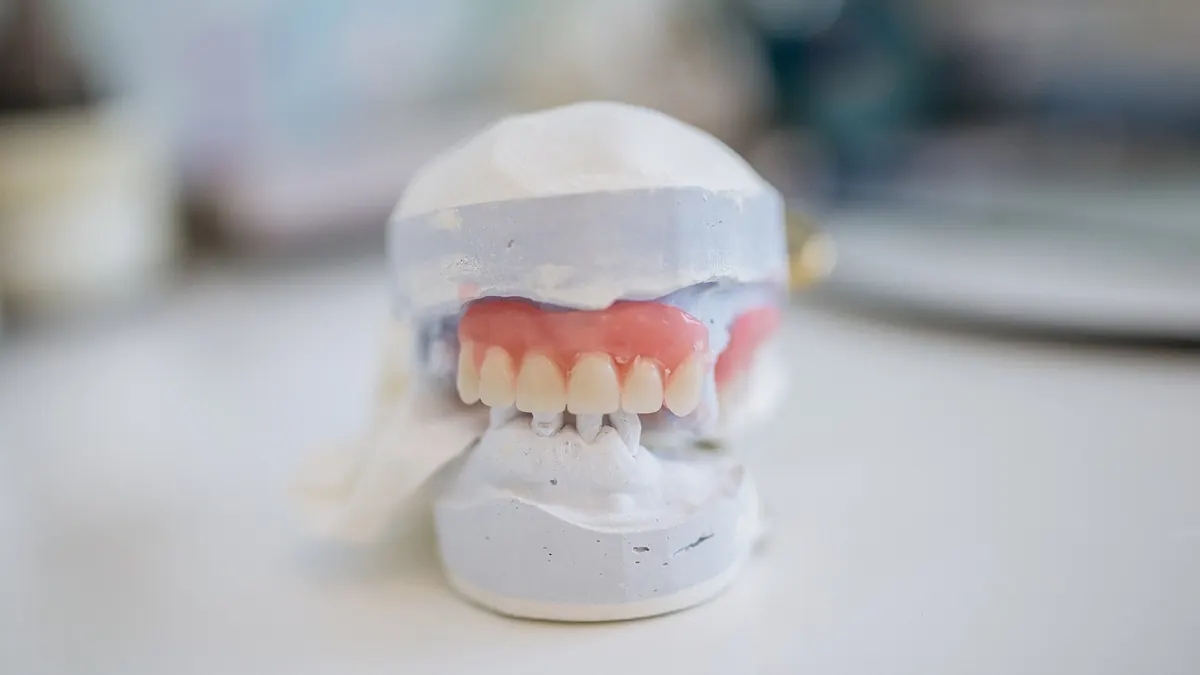
Dentures are removable replacements for missing teeth. The NHS dentures page (reviewed 19 March 2025) describes two main kinds: complete dentures, which replace all the teeth in the upper or lower jaw, and partial dentures, which replace one or more missing teeth and clip around the remaining ones. Both rest on the gums and, in the upper jaw, on the roof of the mouth. Some dentures are supported by dental implants fixed in the jawbone, which hold them more firmly in place.
Dentures are usually made from acrylic resin, sometimes with a metal (cobalt-chromium) framework for strength and a slimmer fit. An immediate denture is one fitted on the same day teeth are removed, so you are not left without teeth while the gums heal.
Who it is for and when it is recommended
Dentures are for people who have lost several teeth or all of them, whether through decay, gum disease, injury or extraction, and who want to restore chewing, speech and facial support. Tooth loss remains common: the World Health Organization's oral health fact sheet (updated 17 March 2025) puts the global prevalence of total tooth loss at almost 7 percent of adults aged 20 and over and about 23 percent of those aged 60 and over.
Compared with bridges and implants, dentures do not require surgery or the shaping of neighbouring teeth, and they can replace many teeth at once. They may suit people for whom implants are not advisable or affordable, or as an interim measure while other treatment is planned. A dentist will also consider the health of any remaining teeth and gums, the shape of the jaw ridges and your dexterity for cleaning.
What happens at the appointment
Making a denture is a series of visits rather than a single appointment:
- Assessment. The dentist examines your mouth, discusses options and may take X-rays. Any teeth that need removing or treating are dealt with first.
- Impressions. The NHS describes the dentist measuring your mouth and making a mould with putty, or taking a digital scan. A second, more precise impression is often taken in a custom tray.
- Bite and shade. Wax rims are used to record how your jaws meet, the height of your bite and where the teeth should sit. You choose the tooth shade and shape with the dentist.
- Try-in. The teeth are set in wax so you can see the appearance and check speech and bite before anything is finalised. Changes are easy at this stage.
- Fitting. The finished denture is inserted, pressure points are eased and you are shown how to insert, remove and clean it.
- Review. One or more follow-up visits adjust sore spots as your mouth adapts.
Expect four to six visits over several weeks. Immediate dentures compress this timetable but, as the NHS notes, often need adjusting or replacing up to a year later because the mouth changes shape as it heals.
How to prepare
Think about what matters most to you: appearance, comfort, cost or speed. Bring old photographs if you want the new teeth to resemble your natural ones. Tell the dentist about medicines, especially any that cause a dry mouth, and about health conditions that affect your hands or your ability to attend several visits. If you have a current denture, bring it; it tells the dentist a great deal about what has and has not worked.
Afterwards and recovery
New dentures feel bulky and strange at first. Speech may be affected for a few days and eating takes practice; start with soft foods cut small, chew on both sides and move to firmer textures gradually. Saliva flow often increases for a while. Sore spots are common in the first weeks and are easily eased by the dentist, so do not try to adjust the denture yourself.
Daily care, as set out by the NHS, includes brushing your gums, tongue and any remaining teeth with fluoride toothpaste morning and evening, removing the denture and brushing it with soft soap or washing-up liquid rather than toothpaste, cleaning it over a basin of water or a towel in case it slips, rinsing after meals, and taking it out at night to soak in water or a denture solution. Wearing a denture overnight is not generally recommended because trapped food increases the risk of gum infections and decay in remaining teeth.
Risks and limitations (sourced)
Dentures do not match the chewing efficiency of natural teeth and can move during eating or speaking, particularly a lower complete denture, which has a smaller area to rest on. The NHS notes that they can become loose over time as the gums and jawbone shrink, and that poor cleaning or a poor fit can lead to a sore mouth, gum infections and other problems. Partial dentures can trap plaque around the remaining teeth, which the NHS gum disease page (reviewed 20 April 2026) identifies as the cause of gum disease, so those teeth need extra care. Dentures can also break if dropped. Regular dental reviews remain necessary even with complete dentures, so the fit and the soft tissues can be checked.
What affects the cost
Fees vary by country, city and clinic. Factors include:
- Complete versus partial, and one jaw or both.
- Material: acrylic alone, a metal framework, or flexible resin.
- Whether extractions, or treatment of remaining teeth, are needed first.
- Whether the denture is immediate (and so likely to need relining or remaking).
- The number of visits and the laboratory used.
- Implant support, which adds surgery and components.
- Coverage by a national scheme or insurance.
Ask for an itemised written quote. HealthNaro does not publish prices unless they come from a named, dated source.
Questions to ask the provider
- Which type of denture do you recommend for me, and why?
- Would a metal framework or implant support make a difference in my case?
- How many visits will it take and how long between them?
- Is there a try-in stage where I can see the teeth before they are finished?
- What is included in the price: adjustments, a review, future relines?
- How long would you expect this denture to last before relining or remaking?
- What should I do if it breaks or a tooth comes off?
How to find and check a provider
HealthNaro lists dental clinics and dentists with a verification label on every listing. Public listing means the details came from public sources and have not yet been checked. Contact verified means the provider has confirmed their phone number and email address. Reviewed by HealthNaro means our team has looked over the listing's details. Credentials verified means we have seen a licence or registration document. A label describes what has been checked; it is not a recommendation or a ranking, and HealthNaro does not endorse any provider.
Check the practitioner's registration with your national dental regulator; in some countries clinical dental technicians are also registered to provide dentures directly. You can browse providers under Prosthodontics. If you would like help finding a suitable clinic, our consulting service is free: send a request through the inquiry form and we will come back to you with options. You choose whom to contact.
This guide is general information, not dental advice. Speak to a registered dentist about your own situation.
If you think you have a medical emergency, contact your local emergency services or go to the nearest emergency department straight away. Do not wait for a reply from a directory listing.
Need help finding prosthodontics?
Tell us what you need and where. We contact you, understand your situation and help you find and choose a suitable clinic. This service is free for patients.
Related guides
-
Guide
A child's dental check-up: first visits, fluoride varnish and fissure sealants
When to take a child to the dentist for the first time, what the visit involves, the preventive treatments that may be offered and how to make it a calm experience.
31 October 2026
-
Guide
Crowns and bridges: when they are used and what the process involves
How a crown protects a weakened tooth, how a bridge replaces a missing one, the appointments involved, aftercare and the factors that drive the price.
31 October 2026
-
Guide
Dental fillings: materials, what happens and how to look after them
Why a filling is needed, the difference between composite, amalgam and glass ionomer, what the appointment involves, and what the regulators say about amalgam.
31 October 2026